Showing posts with label Weird. Show all posts

Friday, 14 December 2012

The world 13 ugliest animals.

Not every animal is as cuddly as a giant panda or as extravagant as a peacock, but every animal has its role to play and every organism is important.


1. California condor
One of the world's rarest birds and North America's largest flying land bird, the California condor is a graceful animal when it is gliding high above the canyons and deserts of the American West Coast.

But up close, this bird isn't so photogenic. Its bald head is an adaptation for its lifestyle as a scavenger, since a feathered head would become clotted with blood while the bird feeds on large carrion.


2. Aye-aye
This gremlin-looking creature, called an Aye-aye, is actually a primate found in Madagascar.

Aye-ayes have a number of unusual traits, including a long, bony, witch-like middle finger that they use to pry insects and grubs from tree trunks. This allows them to fill a biological niche much like a woodpecker might. They are nocturnal, only coming out at night.


3. Red-lipped batfish
The red-lipped batfish gives the impression that it tried to compensate for an unusual body by caking on the lipstick.

Interestingly, they are better suited for 'walking' along the ocean floor than swimming. When they reach adulthood, they use their dorsal fin as a fishing lure to attract prey instead of for swimming.


4. Blobfish
Perhaps it's unfair to judge a fish out of water, but the blobfish looks more like a ball of slime than a living creature.

Blobfish live deep in the ocean, where pressures are exceedingly high. In fact, the blobfish's gelatinous appearance is actually a brilliant adaptation — its gooey, pudding-like flesh allows it to stay buoyant at depths where gaseous bladders can't function.


5. Elephant seal
With massive, floppy trunks, these seals that resemble elephants are capable of making loud, roaring snorts, a handy tool in defending territory.

They are also deceptively fast. Some elephant seals have been clocked wiggling over sand dunes at a speed faster than the average human can run!


6. Hyena
With a hunching, bear-like gait, these scavengers of the savannah aren't the prettiest animals on the planet, but at least they have a sense of humor. Occasionally referred to as "laughing hyenas", their calls are often described as haunting and witch-like.

Though they look like wild dogs, they are more closely related to civets, mongooses and meerkats.


7. Monkfish
These unappetizing, freaky-looking fish are a commonly eaten delicacy.

Monkfish are so grotesque that they have been confused with the legendary sea monster called a sea monk.


8. Naked mole rat
It must be difficult to maintain a vibrant self-image if you're a bald rodent, but it's not an issue for the naked mole rat. These animals live underground in insect-like colonies, and they have little need for good eyesight. Their hairless bodies are also an adaptation for their underground environment.

Interestingly, naked mole rats are also among the longest living of all rodents given their size (they can live for nearly 30 years), and they have a remarkable resistance to cancer.


9. Star-nosed mole
These moles might have the most bizarre noses in the animal kingdom. Their weird whiffers are defined by 22 fleshy appendages that act more like ultra-sensitive fingers than a nose.

The snouts are lined with more than 25,000 minute sensory receptors that help the mole feel its way through its underground lair.


10. Warthog
These wild members of the pig family have the characteristic pig nose, tusks protruding from their mouths, a wart-like curvature to their faces and a nappy mane of hair that cascades down their backside. They aren't an image of beauty, but they are remarkably well-adapted to their harsh environment.


11. Marabou stork
Would you want your newborn delivered by one of these sickly looking storks? Standing over 5 feet tall with a wingspan of more than 10 feet, these African birds are scavengers of large carrion, which is why they have featherless heads. They also eat other birds, and have even been known to consume flamingos.


12. Proboscis monkey
A human might run for cover with this nose, but for the proboscis monkey, the bigger the nose the better! It turns out that nothing turns on a female proboscis monkey more than a big, bulbous schnoz.

The big noses also help the monkeys to make loud, resonating warning calls.


13. Horseshoe bat
Like most insect-eating bats — which use echolocation to catch their prey — horseshoe bats have a warped appearance that looks more like an ear than a face. This adaptation makes them more receptive to sound waves, which allows them to swiftly navigate through the air.


Saturday, 19 November 2011

10 World's Weirdest Foods.

We all got to eat! Since the beginning of time we have been ingesting a wide variety of edibles for survival. Food that pushes the edges or social taboo for one culture is another’s daily bread. Traditional reasons for consuming weird food are often rooted in scarcity and have since graduated to tradition. And you just know our culture has evolved when we start eating weird food for art. A quick trip through the weird food world is fascinating but beware! Your buttons will be pushed, your beliefs will be challenged and you will be hit with “ick” more than once.

Human breast milk cheese


Not stumbled upon for survival nor cultivated for nutritional bias or aphrodisiac legend, this newest topic is doing as it was meant to...generate conversation. Miriam Simun, opened an art installation in New York called The Lady Cheese shop to make a point. She found three women who were willing to donate their milk, screened it for disease and turned it into three flavours with catchy names: West Side Funk, Midtown Smoke, and Wisconson Chew. It is taboo food served up as art. Its intention is clear; it doesn’t hope to stave off hunger, cultivate tradition or uphold skill. It is the symbol of a culture who can spend time thinking about ideas instead of searching for food.

Hakari


Nordic cultures realized that the shark they caught was full of a toxin called urea which could sicken or kill them. Some Viking somewhere must have figured out that if you let that meat rot, the ammonia is emitted and the danger is removed (smelling a lot like the boys’ bathroom). Hanging the rotted flesh to dry was one simple step away from creating a delicacy. This food remains as a tradition or a cultural glue of sorts that is eaten at festivals. Not so different from our current treatment of beef, really but somehow we have successfully replaced the term “rotting” with “dry aging”. That, and the fact that, eating the shark before it was rotted could kill you, the beef would just be tough and bland.

Balut


Think back a few hundred or thousand years. If you were hungry and your chicken wasn’t laying any unfertilized eggs but you could find a fertilized one, would you have eaten it? Embryo, yolk and all? Of course you would have! But would you now? This Philippine street food pushes the limits of our North American species acceptance. We can stomach the idea of eating the egg but once it has another purpose...not so much. The Balut eggs are fertilized and kept warm to encourage growth to a specific stage that is different for ducks and chickens. They are then cooked and eaten warm right out of the shell, pan fried or served in soup. The visual and the texture would never fly here as a mainstream food but back in the Philippines, they swear by it.

Casa Marzu cheese


In the category of “well, we still have to eat it!” comes a Sardinian cheese specialty. Pecorino is delicious as it is but it apparently gets more so when this delicacy is cultivated with a maggot-like larvae to improve it. The larvae partially consume the cheese to render it sweeter. Not that bizarre of a concept given that it is microscopic microbial enzymes that make cheese in the first place. However, this delicacy with a “traditional designation” protecting it trumps safety concerns goes much further. It is the visibility of the movement that excites some and disgusts many. There are those who remove the larvae before consuming and those who do not. Which would you be?

Kopi Luwak coffee


Who on this green earth discovered that coffee tastes better when defecated by a civet cat? It’s fun to imagine the rascally cat getting into the last of the coffee and some desperate Indonesian coffee addict thinking “well, better drink it, it’s all we have got!” The miraculous discovery that the civet’s stomach acid would partially digest the coffee beans, which would smoothen and round out the coffee’s flavour must have been a surprise. This happy accident turns to gold when the “process” is so sweet as to turn waste into the most expensive coffee on earth. Rest assured; no danger lurks here since the beans are well washed and then roasted which would kill any offending traces. Sort of.

Sannakji


Speaking of movement, this one takes the title for “extreme eating”. In Korea, you can test your gag reflex with live, squirming octopus that has been harvested live, chopped, seasoned with sesame oil and served. You will be cautioned that the suction cups are still active and present a choking hazard, thus making it one of the world's most dangerous foods as well. Also be forewarned that all of the rules concerning eating raw fish still apply.

Tarantula


Relatively new to the scene and suspected to be the result of food shortages in the 1970s in Cambodia, this is the ultimate arachnophobes’ revenge: tarantula eating. Call it a conspiracy theory, but they are said to improve the shine and thickness of one’s hair as well as being delicious! It is advised that you remove the tooth before eating the gooey and nutty body whole. A couple of legs at a time is all that this texture will allow but much of the flavour actually depends upon the seasoning. Most are served whole and fried with species dismemberment usually left up to the customer.

Fugu


A refined and cultivated art of learning how to properly carve this blowfish is a two year apprenticeship program in Japan. One wrong slip of the knife to sever the liver and the ovaries and death to diners is the result. There are strict regulations around who can grow, fish, cut and even enjoy this delicacy. Discarded toxic pieces are kept under lock and key. It is the revered and yet forbidden fruit for the emperor, its deliciousness must not pass his lips lest he die. Others however may eat it raw or quickly immersed in hot broth. This is not peasant food or necessity; it is an elevated and privileged dish. Celebrity chef Bob Blumer survived to tell the tale of its taste, as did Anthony Bourdain.

Monkey Brains


At the utter extreme end of our human tolerance for cruelty is that of the refuted habit attributed to the Chinese of consuming monkey brains. The “cute factor” makes monkeys feel so close to humans that we cannot imagine consuming any part of them, let alone their brains. Certainly challenged is the story of brains being consumed live, although it is possible that they are pan fried and served for lunch as the erroneous legend prevails that they cure impotence. To clarify a myth, our own delicacy of sweetbreads does not come from brains. They are merely glands that look like brains. Way less gross, right?

Grasshopper


It may seem tame after monkey brains but is still enough to make some think twice before indulging in them. In Mexico and China grasshoppers are prized for their protein. There appears to be no cultural significance to the catching and crunching of this widely available source of survival. It’s easy to catch, abundant and free (and apparently tasty). Eating them raw carries a risk of tapeworm so most are place in water for 24 hours and then boiled, sun-dried, spiced and fried or used in soup. Think soft shelled crab and take a deep breath.

Thursday, 15 September 2011

10 Unusual Food Record

Some people are doing an unusual thing with food and drink - they are using them to set records.
So what else can you do with food? We all know you can gather it, cook it, and eat it but some go one step further and break records with it. It seems we find no end of amusement in our food. Here are some of the unusual records set across the globe.

World's largest tomato fight
Every year in Bunol, Spain they have the world’s largest tomato fight . Forty thousand people throw 130 tons of over ripe tomatoes for an hour in the town’s centre, Plaza del Pueblo. The tomatoes are dumped from trucks upon the population (plus an additional 30,000 visitors and revellers) for them to fight, toss, smear, roll, mash, lob and laugh. The town is painted red and then hosed down. What else are you going to do with 130 tons of overripe tomatoes anyway?


World pizza slap record
Who knew that slapping a pal in the face with pizza was even a record? And what’s a record without rules? The contestants may only use two slices of pizza and direct all slaps at the face. It was first set by Erin O’Keefe and Amy Milano in New York when they slapped each other 174 times in 15 seconds. However, their record was soon broken by two journalists on the Today Show who managed 264 pizza slaps in the same amount of time on live television. 


Oldest Hot Cross Bun
Hot Cross buns are religious relics but this one takes the cake. It is believed that the fruity buns will not mould if baked on a Good Friday. And to put that theory to the test, one family has carefully preserved their bun for generations. The world’s oldest bun is 189 years old and resides in England. It was born, or rather baked, in 1821 - the same year Napoleon died. Owner Nancy Titman was given the bun by her mother. She told The Telegraph in an interview ''It is rock hard and the currants have disintegrated but you can tell it's a hot cross bun and you can still see the shape of the cross.'' 
Largest monument to the onion
When you say “Oh, I love onions” how committed are you? Committed enough to build a monument that stands 6.5 metres high? A Romanian onion tycoon, Alexandru Tartar, commissioned such a stone, iron, concrete and resin structure as a nod to the vegetable’s its ‘flu fighting properties and simple deliciousness. Although not edible, the structure reflects the vegetables natural colour tones and was uncovered by the Tartar himself.

Largest number of people simultaneously licking ice cream
Sharing ice cream with friends on a warm day is pleasure enough. But this summer tradition just gets better when shared with 2,693 of them. The world record for largest group of ice cream lickers goes to Augustana College, Illinois where devotees gathered, ordered and indulged in Wgitey's Ice Cream. In fact, the company even created a new flavour aptly called Augustana Viiking Pride, which consisted of peanut butter with fudge swirls and Oreo cookie chunks. But this dessert indulgence wasn’t just for any old reason. They were celebrating the college’s 150th anniversary.
Largest canned food structure
You know those precarious displays of canned goods at the grocery store? The ones you are a little afraid to reach into to retrieve a desired item. What if they had a purpose beyond just making you scared and promoting a brand? One town, Wellington, New Zealand decided to make a great show of gathering food for the needy. They knocked on doors, asked for donations and then used them to break the record by building the world’s largest structure made of cans. It used 52,547 cans that basically equated to 360 square metres of Good Samaritan. When the structure was dismantled, all food went to the food bank.


Largest ketchup package
Sometimes fame comes in strange packages. These record breakers in Collinsville, Illinois found inspiration in a school that burned down. So the town decided to break a Ketchup record to rebuild it! They charged $1 for each of the 4,000 bottels donated by H.J. Heinz Co. and participants had the pleasure of pouring their bottle into a packet. Not just any packet, but one that held 130 gallons of the popular condiment. Once filled, the community broke a record for having the world’s largest ketchup packet. 

Most expensive pot
You’ve probably heard of the world’s most expensive foods, so why not the world’s most expensive pot? Cue German pot maker Fissler that created this blinged out 28 centimetre saucepan from one kilogram of gold and studded it with 200 diamonds. The cost of making it was over £100,000 and it is showcased at Harrods on a custom pedestal crafted from rootwood. We’re guessing that it isn’t available to make some mac and cheese.
Most number of drink cans balanced
What do you do with 429 cans of 7 Up weighing 173 kilograms? Well, if you’re John Evans, a head balancing strongman from the UK, you’ll be able to perfectly balance the whole stack on your head for 15 seconds. Mr Evans broke his own previous record for the feat, which formerly featured 428 cans. While there was no motivation for the record breaking attempt, Evans is known to have raised over 180,000 for charity balancing various things from milk crates to bricks and a car on his head.

Biggest coffin
Bringing a whole new meaning to “food to die for” is a record breaking coffin. It turns out to be the world’s largest restaurant. It is decorated with funeral wreaths and low candles to offset the sense of macabre. Set in a town called Truskavets, Ukraine, it was built to encourage tourism. Likely the town’s other highlight, healing, and mineral rich bathing waters is a bigger draw.


Friday, 29 July 2011

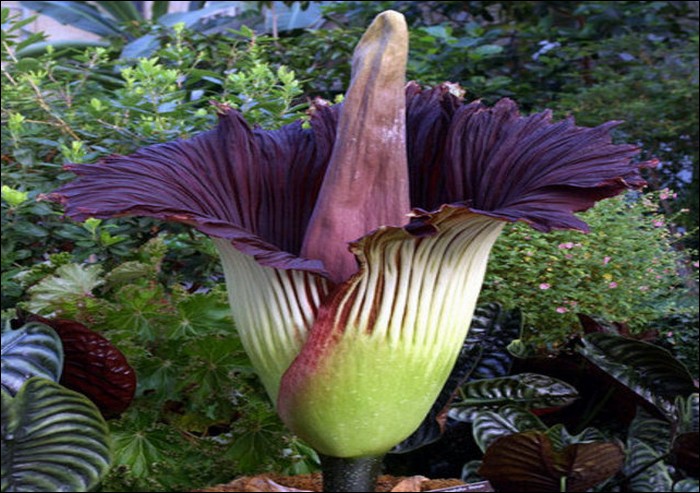
The biggest and stinkiest flower in the world.


The titan arum has a massive inflorescence (flowering structure) consisting of a spathe (collar-like structure) wrapped around a spadix (flower-bearing spike). The spathe is the shape of an upturned bell. It is green speckled with cream on the outside, and rich crimson on the inside.

It has ribbed sides and a frilled edge, and can be up to three metres in circumference. The flowers are carried on the lower end of the greyish-yellow spadix. At the base of the spadix, within the protective chamber formed by the spathe, is a band of cream male flowers above a ring of the larger pink female flowers. When the flowers are ready for pollination, the spadix heats up and emits a nauseating smell. This stench is so bad that the Indonesians call the plant ‘the corpse flower’.

The inflorescence rises from a tuber, a swollen underground stem modified to store food for the plant. This tuber, more or less spherical in shape and weighing 70 kg or more, is the largest such structure known in the plant kingdom.


Friday, 8 July 2011

What the hell are these guys doing?

People takes things to extreme and sometime you ask yourself, "what the hell are these guys doing?". The following pictures shows how far people can go. While some are amazing, funny some are well, you figure it out!


back to top //PART 2