Friday, 20 July 2012

Fascinating tree house hotels.


Does this in any way resemble your list of requirements when it comes to booking the ideal summertime getaway? If so, there are more than a couple of treehouse lodgings and full-on treetop resorts out there to indulge
Appealing to solace- and adventure-seekers alike, treehouse hideaways can range from rustic (bunk beds and shared facilities) to luxurious (flat-screen TVs and infinity pools) and can be found on almost every woodsy corner of the globe from the Ozarks to Oregon to the Amazon River.


Ariau Amazon Towers Hotel
Manaus, Brazil
Inspired by the rain forest conservation efforts of Jacques Cousteau and nearing its 20th year in operation, Brazil’s Ariau Amazon Towers Hotel remains the dazzling grande dame of treetop resorts. Situated outside the city of Manaus on the banks of the Rio Negro, a major tributary of the mighty Amazon, this stunning, bucket list-worthy escape is essentially a complex of stilted wooden buildings that are lifted high into jungle canopy and connected by over five miles of dizzying catwalks. While most of the 268 rooms are spread throughout the property’s eight towers, a smattering of “Tarzan Suites” and private treehouses are also up for grabs. This includes the Tarzan House, which includes a sky-high honeymoon suite built 72 feet (gulp) above the rain forest floor in a living mahogany tree that’s decidedly not for the faint of heart.

Despite the uber-exotic trappings — instead of rowdy spring breakers, you share the resort with monkeys, macaws, parrots, sloths (!) and a host of other colorful critters — a stay at the Ariau Amazon Towers Hotel isn’t exactly roughing it as standard rooms include air conditioning, private bathrooms and mini-bars. Still, this isn’t the Ritz — or a Carnival cruise — so instead of zoning out in front of a flat-screen TV, spending the entire day being pampered at a spa or lazing about at the pool for hours on end (yes, there is one), guests are encouraged to embark on a wide array of eco-tourism adventures including piranha fishing, canoeing, helicopter rides, dolphin swims, and treks deep into the rain forest on jungle survival tours.


Cedar Creek Treehouse
Ashford, Wash.
Perched high — and we mean high as you must conquer five flights of stairs — above the forest floor 10 miles from the Nisqually River entrance to Mount Rainer National Park, Cedar Creek Treehouse is every extreme tree house-lover’s dream come true. Situated 50 feet up in a Western Red Cedar, this bilevel solar-powered retreat is completely off the grid (it’s heated by propane in the winter and the “loo with a view” is sans shower) and features a tree trunk growing right through the middle of the floor. Can’t get much more authentic than that, eh?

Back down on the ground, guests at Cedar Creek can partake in a range of outdoor adventures (fishing, hiking, biking, foraging, you name it) or unwind at the property’s creekside picnic area which includes a campfire pit and charcoal grill (did someone say s’mores?). For the able-bodied and non-faint-of-heart, a visit to the Cedar Creek Treehouse isn’t complete without a guided tour of owner/builder Bill Compher’s Treehouse Observatory, a structure located 100 feet up a fir tree that’s accessible by ascending the Stairway to Heaven, an 82-foot spiral staircase, and then crossing a colorful, 43-foot-long suspension bridge dubbed the Rainbow Bridge. As you can imagine, the views on a clear day are beyond breathtaking.


Tree Houses Hotel
Santa Clara, Costa Rica
Boasting six stilted abodes named after a few of the local residents (Sloth, Toucan, Frog, Monkey, etc.), Costa Rica’s Tree Houses Hotel is less of a full-on jungle resort and more of an intimate bed and breakfast that just happens to be surrounded by a 70-acre wildlife refuge. Sure, the available lodgings (they start at a mighty reasonable $95 a night) may technically not be true treehouses but, hey, any structure that’s elevated high into the jungle canopy and includes running hot water, AC, a full bathroom and a nearby parking spot is A-OK with us.

Although guests can feel free to go ahead and embrace their inner sloth by spending an entire idle day unwinding on an oversized private deck with a pair of binoculars and a good book, the Tree Houses Hotel also serves as an ideal embarkation point for a myriad of eco-tourism expeditions in the area including volcano hikes, safari floats, canoeing, zip lining and birding. Given that guests may be (understandably) sore after a day spent navigating an inflatable kayak down the Arenal River, a licensed masseuse is available for hire to knead away any aches and pains.


The Grand Treehouse Resort
Eureka Springs, Ark.
While many treetop hotels are located in decidedly far-flung locales such as the Swedish Lapland or the Amazon rain forest, domestic travelers needn’t look any further than the Ozarks to get their “Swiss Family Robinson” on. Situated in a densely wooded area right outside of the artsy, LGBT-friendly Victorian resort village of Eureka Springs, the owners of The Grand Treehouse Resort offer up several different arboreal lodgings including the Cedar Manor, the Sanctuary and the Big Pine to choose from. We’re pretty much smitten with all of ‘em. And for those seeking woodsy solitude but who don’t take too well to stairs, bridges or inclines of any sort, there’s also the perfectly charming Gate House.

Boasting Wi-Fi, luxury bed linens, flat-screen TVs and Jacuzzi tubs, guests may be tempted to hunker down completely in their stilted or non-stilted cabins (for some reason, we don’t think that the Fritz, Ernest and the rest of the shipwrecked SFR clan had the pleasure of drying off with Egyptian cotton towels) for a spell. But for those craving a full-on taste of the Ozarks and its myriad charms, there’s no dearth of outdoor, cultural and, umm, biblical, attractions in the immediate area worth exploring.


Out 'n' About Treesort
Takilma, Ore.
While the relentless use of woodsy portmanteaus displayed on the website of southern Oregon’s Out ‘n’ About Treehouse Treesort may prove to be a bit much for even the most seasoned of arboreal escapists (“activitrees,” facilitrees,” “amenitrees” and on and on), we suppose it’s only appropriate: the folksy, 36-acre Ewokian fantasyland on the edge of the Siskiyou National Forest is the location of treehouse guru/builder Michael Garnier’s Treehouse Institute of Takilma, an institution described as the only place in the world that offers avocational instruction in basic engineering, design and construction methods for building treehouses” (you can also enroll in seminars in tie dying, horseback riding, forest ecology, map reading and composting if so inclined).

Whether or not you decide to partake in any of the courses and activities offered by the Institute, you’ll find a wide range of elevated overnight accommodations at the Treesort including the Pleasantree, the Treezeebo, the Calvatree and the Majestree. Suffer from acrophobia or require a full, noncommunal bathroom? There are also a few just as rustic but closer-to-the-ground lodging options that you needn’t cross a terrifying swinging suspension bridge, scale a ladder or climb multiple flights of stairs to access. Despite the whimsical vibe that prevails at the Treesort — the full breakfast includes an unlimited supply of “Fantasy Flakes” — the real world requires that guests sign an assumption of risk agreement and leave their pets at home. And did we mention that there are multiple zip line courses just steps — or swings, rather — away from the main compound?


Tranquil Resort at the Kuppamudi Coffee Estate
Wayanad, India

Dubbed as a “Plantation Hideaway,” Tranquil Resort is located on a 400-acre private estate complete with a working coffee and spices plantation near the southwest coast of India in the unbelievably lush, sparsely populated district of Wayanad in the state of Kerala. For those unfamiliar with Kerala, it’s, well, paradise. Offering full luxury resort amenities and services with an intimate, B&B-ish twist (travelers are treated as extended family and share communal meals with the property owners and staff), a majority of Tranquil guests sleep in one of several private rooms located in a renovated annex attached to the main home that was originally built to accommodate friends and family of the plantation owner.

While perfectly lovely, those rooms don’t hold a candle to Tranquil’s two elevated sleeping options: The Tree House and the Tree Villa (shown here), the latter being a sprawling (1,080 square feet!) sanctuary with double verandas that towers 35 feet above the estate. Heck, one of the two bathrooms even has panoramic views. When guests do eventually decide to descend to ground level from their insect-proofed tree retreats, they can indulge in an in-house Ayurvedic spa treatment, unwind in the killer-looking swimming pool or enjoy a leisurely extended constitutional around the estate. Additionally, Tranquil-ites may opt to embark on a day trip to a range of nearby attractions including the Edakkal Caves, Pookote Lake and the elephant-filled Muthanga Wildlife Sanctuary — all experiences worth writing home about or, at the very least, sharing around the dinner table with Victor, Ajay, Anjini, Nisha and the rest of the Tranquil Resort family.


Tsala Treetop Lodge
Plettenberg Bay, South Africa
Although we’ve never actually visited the stunning glass, stone and wood retreats that make up Tsala Treetop Lodge, if we had we’d imagine that you’d have to drag us away kicking and screaming for one reason and one reason only: private, sky-high infinity pools set amidst the lush canopy of an indigenous forest. OK, so maybe there are numerous reasons why we’d be reluctant to end a stay at this secluded South African luxury property other than the infinity pools found in each of the 10 well-appointed treetop suites or six two-bedroom villas that are linked by a network of elevated wooden walkways, but they’re certainly a biggie. The others? We’re pretty keen on forest picnics, birding opportunities galore and excursions to nearby elephant and primate sanctuaries and Birds of Eden, the largest free-flight aviary in the world.

Whatever the case, such arboreal opulence doesn’t come cheaply: Rates for a treetop suite at Tsala — “friend” in an indigenous language — start at $220 per person during the off-season, while rates for a single supplement during the peak season are as high as $500. That said, it’s probably best to bring along a tsala … or three.


Treehotel
Harads, Sweden
Tucked away in a remote stretch of boreal forest in the northern reaches of Sweden along the Lule River — guests who'd prefer not to make the 11-hour-plus drive from Stockholm can opt to arrive via helicopter or rent a car or snowmobile from the Luleå airport — the Treehotel is about as enchanted — and design-y — as sylvan shelters get. Comprising five elevated structures perched anywhere from 13 to 20 feet above the forest floor, Britta and Kent Lindvall’s eco-conscious escape received a massive amount of international press when completed in 2010. You needn’t look any further than the Mirrorcube, a boxy, pine-tree-bound pied-à-terre with an exterior completely clad in reflective glass to understand why.

In addition to the Mirrorcube, other contemporary quarters include the Bird’s Nest (yes, it really looks like one), the UFO (ditto), the Cabin (it’s “like a capsule, a foreign body in the trees”) and the Blue Cone, a more feasible option for acrophobics that’s accessible by a long ramp in lieu of a retractable staircase or bridge. Designed by a host of top Scandinavian architects and constructed using low-impact materials, each of the existing five “treerooms” (several more are in the works) include LED lighting, water-efficient sinks, combustion toilets and slick custom furniture. And because this is Sweden that we’re talking about, guests can kick back and relax in the Tree Sauna after a long day of hiking, biking, fishing, sledding, snowshoeing or horseback riding. Sign. Us. Up.

source: mnn.com


Friday, 13 July 2012

Unique ways animals see the world: Infographic


Have you ever stopped and wondered what version of the world your beloved dog or cat sees the world in? How is their perception colored and how do they perceive you? Most of us take for granted the gift we are granted with sight, but it may surprise some of you to find out that many animals actually have much better vision than we do. In fact, some see the world with some precision and accuracy, they put our eyesight abilities to complete shame. Read on to learn more about the unique ways our animal friends see the world


Credit to Mezzmer.com


Monday, 25 June 2012

The world cutest caterpillars.

Caterpillars are high in protein and rather defenseless — making them an easy dinner staple for other animals — and many have evolved various means of protection. Their markings and body parts can make them seem larger in size or even poisonous. In fact, some of them are poisonous, both to consume and to the touch.

But before you go out and start squishing caterpillars, remember that they are not vicious and stinging only occurs when they are touched and feel threatened.

Pine processionary caterpillar (Thaumetopoea pityocampa) 

Somebody needs a haircut — but then somebody would be much less dangerous and not nearly as cute. The larvae of the pine processionary moth could be the model for caterpillar shampoo if there were such a thing.

But all that hair, touchable as it may look, should never be touched. Not only are the extremely irritating hairs harpoon-shaped, but the caterpillar can eject them when threatened, at which point they penetrate all areas of exposed skin, replete with urticating venom.

Hag moth caterpillar (Phobetron pithecium)

Question: Cute fuzzy octopus monster that could be a plush toy? Or, an arachnophobe’s worst nightmare?

Whichever camp you’re in, one thing’s for sure: there’s little mystery as to why this caterpillar garnered its nickname, the “monkey slug.”

Complete with six pairs of curly projections densely covered in hairs — the “limbs” can fall off without harming the larvae, but the hairs can cause some fierce irritation.

Saddleback caterpillar (Acharia stimulea)

Taking the prize for “Caterpillar Most Resembling a Chinese New Year Dragon,” the cute and beautiful saddleback caterpillar is native to eastern North America, although it looks better suited for much more exotic climes.

The pert pompoms these caterpillars sport are more than decorative. Like much of the rest of this creature's body, the pompoms bear urticating hairs that secrete irritating venom. The stings are very painful, and they can cause swelling, nausea, and leave a rash that can last for days.

Giant silkworm moth caterpillar (Lonomia oblique)

Nature got it right with this one — it's designed it to look as scary as it is. This is not the caterpillar you want to meet in a dark alley. Known as the “assassin caterpillar,” the South American larvae are responsible for at least 500 deaths, and probably many more.

The spear-like bristles penetrate the skin and deliver a dose of toxin which leads to headache, fever, vomiting and malaise before a severe bleeding disorder ensues leading to ecchymosis, hematuria, pulmonary and intracranial hemorrhages (yes, that's blood flooding the brain), and acute renal failure.

Io moth caterpillar (Automeris io)

Animal, vegetable, mineral ... caterpillar! Like a tiny oasis of palm trees, the sweet, colorful io moth caterpillar has a broad range, from Manitoba and in the southern extremes of Ontario, Quebec, and New Brunswick in Canada, to Montana, North Dakota, South Dakota, Nebraska, Colorado, New Mexico, Texas, Utah, east of those states and down to the southern end of Florida. Io gets around.

And yes, those frond-like spines have a painful venom that is released with the slightest touch. Some people experience severe reactions and require medical attention, while some only itch or have a burning sensation.

Puss caterpillar (Megalopyge opercularis)


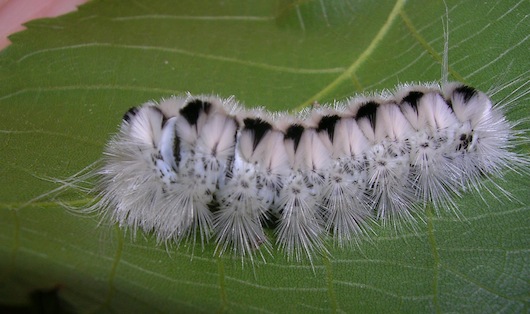
The Cousin Itt of caterpillars, this guy (pictured above) goes by the name of puss caterpillar or asp — and both names make sense. Puss, because this total cutie pie is as fuzzy as a kitty; and asp, as in snake, because this is one of the most toxic caterpillars in North America.

The venom comes from poisonous spines neatly concealed by the irresistibly fuzzy surface. When touched, the spines break off and lodge in the skin, releasing the venom. Mother Nature at her sneakiest. According to the toxin library of the American Association of Clinical Chemistry (AACC), this is no simple sting: Intense throbbing pain develops within five minutes of contact, with pain extending up the affected arm. Other symptoms may include headaches, nausea, vomiting, intense abdominal distress, lymphadenopathy, lymphadenitis, and sometimes shock or respiratory stress.

White cedar moth caterpillar (Leptocneria reducta)

As described by the Coff’s Harbour Butterfly House, by day the white cedar moth caterpillar “hides in crevices on or near the ground. In the gloom of an evening, they swarm as a seething mass of hundreds of hairy brown bodies, undulating in eerie silent flow up the tree trunk and along the branches to the leaves, which they eat voraciously … when a tree becomes defoliated, they wander everywhere looking for another one.”

This caterpillar that’s reminiscent of an angora sweater can indeed pack a punch — the bristles are capable of inducing a frightful case of urticaria.

Hickory tussock caterpillar (Lophocampa caryae)

Such elegance! Dapper, with its velvety back and sweeping bristles, this creature looks more vintage feather boa than larva — but larva it is. And stinging larva, at that. Although some people have little to no reaction to this caterpillar, others have a reaction that ranges from a mild to a fairly severe rash comparable to poison ivy.

In case of stings

Should you get stung by a caterpillar, Poison Information Center recommends this treatment: Place Scotch tape over the affected area and strip off repeatedly to remove spines. Apply ice packs to reduce the stinging sensation, and follow with a paste of baking soda and water. If the victim has a history of hay fever, asthma or allergy, or if allergic reactions develop, contact a physician immediately.


Thursday, 7 June 2012

10 world's oldest living trees.


There are colonies of clonal trees that have lived for tens of thousands of years, but there's something majestic about a single tree able to stand on its own for millennia. These ancient trees have bore witness to the rise and fall of civilizations, survived changing climates,
and even persevered through the fervent development of human industry. They are a testament to the long view that Mother Nature takes in tending the Earth. With that in mind, consider the world's 10 oldest living trees.

Methuselah


At 4,841 years old, this ancient bristlecone pine is the oldest known non-clonal organism on Earth. Located in the White Mountains of California, in Inyo National Forest, Methuselah's exact location is kept a close secret in order to protect it from the public. (An older specimen named Prometheus, which was more than 5,000 years old, was cut down by a U.S. Forest Service graduate student in 1964.) Today you can visit the grove where Methuselah hides, but you'll have to guess at which tree it is. Could this one be it?


Sarv-e Abarqu


Sarv-e Abarqu, also called the "Zoroastrian Sarv," is a cypress tree in Yazd province, Iran. The tree is estimated to be at least 4,000 years old and, having lived through the dawn of human civilization not far away, it is considered an Iranian national monument. Many have noted that Sarv-e Abarqu is most likely the oldest living thing in Asia.

Llangernyw Yew


This incredible yew resides in a small churchyard of St. Dygain's Church in Llangernyw village, north Wales. About 4,000 years old, the Llangernyw Yew was planted sometime in the prehistoric Bronze Age — and it's still growing! In 2002, in celebration of the golden jubilee of Queen Elizabeth II, the tree was designated as one of 50 Great British trees by the Tree Council.

Alerce


The Alerce is a common name for Fitzroya cupressoides, a towering tree species native to the Andes mountains. There's almost no telling how old these trees can get, since most of the larger specimens were heavily logged in the 19th and 20th centuries. Many botanists believe they are the second-longest living trees on Earth aside from the bristlecone pine of North America. To date, the oldest known living specimen is 3,640 years old.

The Senator


The Senator, located in Florida, is the largest bald cypress tree in the United States, and it is widely considered the oldest of its species known to exist. It is likely the largest U.S. tree of any species east of the Mississippi River. Estimated to be around 3,500 years old, the Senator was used as a landmark for the Seminole indians and other native tribes. The Senator's size is particularly impressive because it has endured many hurricanes, including one in 1925 which reduced its height by 40 feet.

The tree gets its name from from Sen. M.O. Overstreet, who donated the tree and surrounding land in 1927.


Patriarca da Floresta


This tree, an example of the species Cariniana legalis named Patriarca da Floresta in Brazil, is estimated to be about 3,000 years old, making it the oldest non-conifer in Brazil. The tree is believed to be sacred, but its species is widely threatened due to forest clearing in Brazil, Colombia and Venezuela.

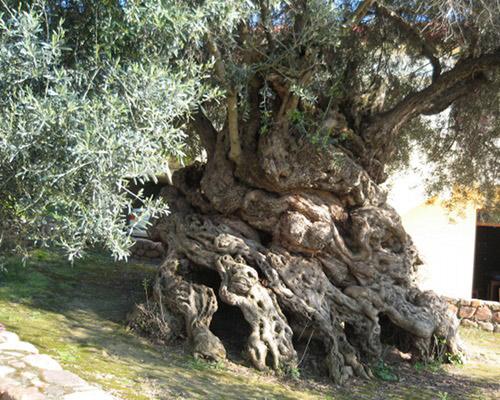
Olive Tree of Vouves


This ancient olive tree is located on the Greek island of Crete and is one of seven olive trees in the Mediterranean believed to be at least 2,000 to 3,000 years old. Although its exact age cannot be verified, the Olive Tree of Vouves might be the oldest among them, estimated at over 3,000 years old. It still produces olives, and they are highly prized. Olive trees are hardy and drought-, disease- and fire-resistant — part of the reason for their longevity and their widespread use in the region.

Jōmon Sugi


Jōmon Sugi, located in Yakushima, Japan, is the oldest and largest cryptomeria tree on the island, and is one of many reasons why the island was named a UNESCO World Heritage Site. The tree dates to at least 2,000 years old, but some experts believe it could be older than 5,000 years old. Under that theory, it's possible that Jōmon Sugi is the oldest tree in the world — even older than Methuselah. Regardless of the numbers, it's a tree that deserves mention here.

Chestnut Tree of One Hundred Horses


This tree, located on Mount Etna in Sicily, is the largest and oldest known chestnut tree in the world. Believed to be between 2,000 and 4,000 years old, this tree's age is particularly impressive because Mount Etna is one of the most active volcanoes in the world. The tree sits only 5 miles from Etna's crater. The tree's name originated from a legend in which a company of 100 knights were caught in a severe thunderstorm. According to the legend, all of them were able to take shelter under the massive tree. It is listed by Guinness World Records as having the "greatest tree girth ever," at 190 feet in circumference.

General Sherman


Believed to be around 2,500 years old, General Sherman is the mightiest giant sequoia still standing. The volume of its trunk alone makes it the largest non-clonal tree by volume in the world, even though its largest branch broke off in 2006, smashing part of its enclosing fence and cratering the pavement of the surrounding walkway. Perhaps this was a sign that General Sherman could not be caged in? Sherman can be found in Sequoia National Park in California, where five of the 10 largest trees in the world exist.


Wednesday, 16 May 2012

25 funniest in honest advertising.

The business of designing and writing advertisements is the activity of attracting public attention to your product or business, and the following not only funny, but also honest promotion of goods or services to the public. The message in these advert is characterized by truth; not false.


back to top //PART 2